Title: The Physics of Stamping: Plastic Deformation and Separation as the Core of Die Design
August 24, 2026
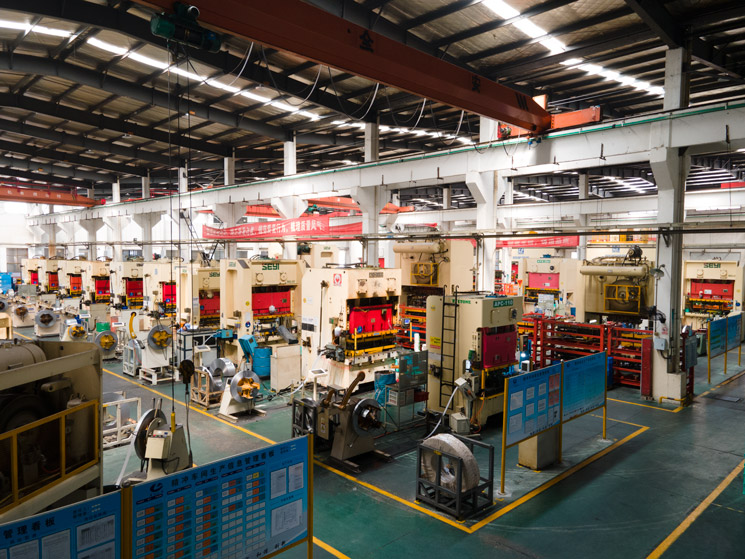
Every stamping die, whether it’s producing a 0.5mm electronic shielding cover or an 8mm automotive chassis reinforcement, operates on the same fundamental physics: the material undergoes elastic deformation, then plastic flow, and finally dimensional stabilization within the die cavity. This is not a theoretical abstraction—it directly dictates die life, part accuracy, and production stability. For progressive dies, the step pitch is typically held within ±0.003mm, and the bending angle deviation at each station must not exceed 0.5°. If this tolerance is violated, springback accumulates along the strip, and the final part will drift out of spec. Experienced die setters know this instinctively: they first check the burnish zone ratio on the scrap cross-section before touching any adjustment screw.
In practice, the shear zone on a cold-rolled steel blanked edge is a reliable diagnostic tool. Under normal clearance, the burnish zone should account for roughly one-third of the material thickness. If it exceeds half the thickness, the die clearance is too tight—this accelerates flank wear, increases punching force, and can lead to galling on the die surface. Conversely, if the burnish zone is too small, the clearance is excessive, causing larger rollover and a rougher fracture zone, which is often a precursor to burr formation. For high-volume production, monitoring this ratio every few thousand strokes is more effective than waiting for dimensional failures. It gives you an early warning on punch edge rounding, stripper wear, and even lubrication consistency.
Understanding this separation and deformation logic also helps in troubleshooting multi-stage dies. For example, if a progressive die produces excessive bowing on a 2mm thick high-strength steel part, the root cause is often an imbalance between the bending and trimming stations, not the material itself. Adjusting the sequence or adding a coining step can resolve it without changing the die steel. This is why a solid grasp of plastic deformation mechanics is non-negotiable for any mold engineer. And when you need to source specialized dies, tooling components, or stamping services, visiting MoldWorld (www.moldw.com) offers a practical starting point for comparing suppliers and technical capabilities.